The evolution of education can be traced through the changing identity of the learner—from the one who performs the work, to the one who directs it, to the one who designs it, and finally to the one who conducts an entire intelligent system. In each era, the teacher’s core responsibilities remain constant: to validate genuine student competence and to develop sound judgment about which processes, tools, and pathways are most appropriate for solving a given problem.
Student as the Tool
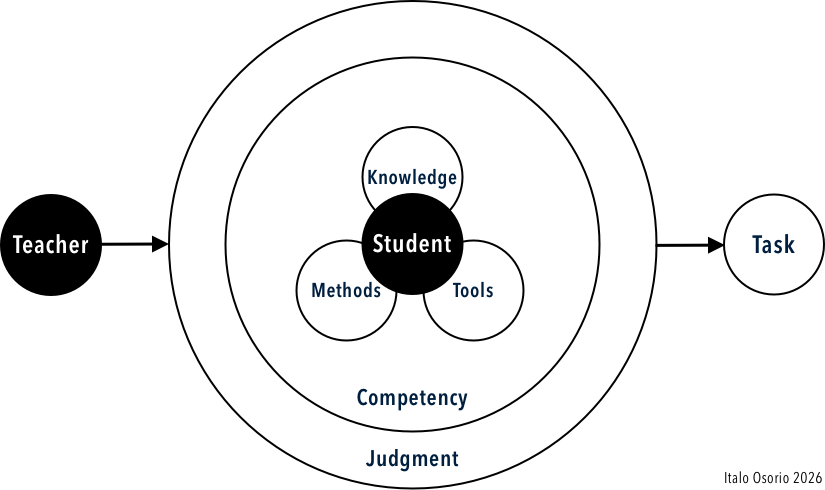
In the Student as the Tool period, learners themselves embodied the knowledge, calculations, and methods of execution. The teacher drilled facts, procedures, and manual techniques—long division, trigonometric tables, grammatical parsing—so the student could carry out every step without assistance. Here, the student was the instrument for calculation, reasoning, and problem-solving.
Student as the Operator
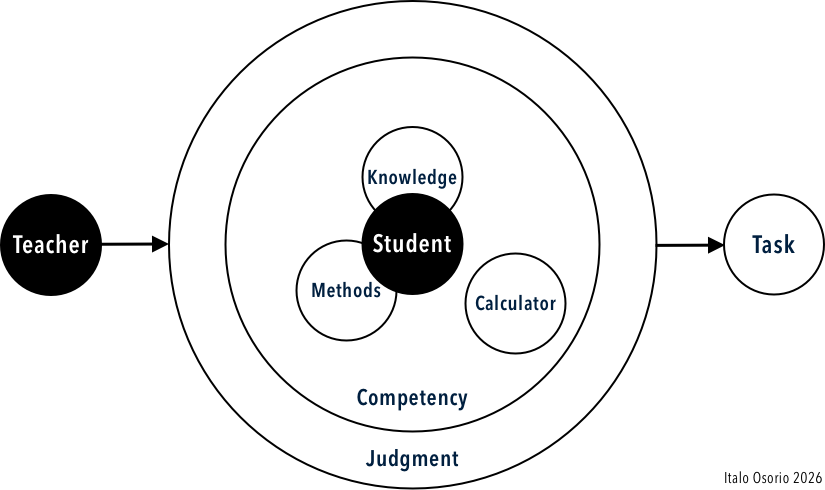
The pocket calculator marked the transition to the Student as the Operator. Computation was outsourced to the machine; the student no longer needed to be the calculator but had to become its skillful user. Instruction, therefore, emphasized conceptual understanding, estimation, error detection, and the intelligent selection and application of the external tool. The student moved from executor to operator.
Student as the Strategist
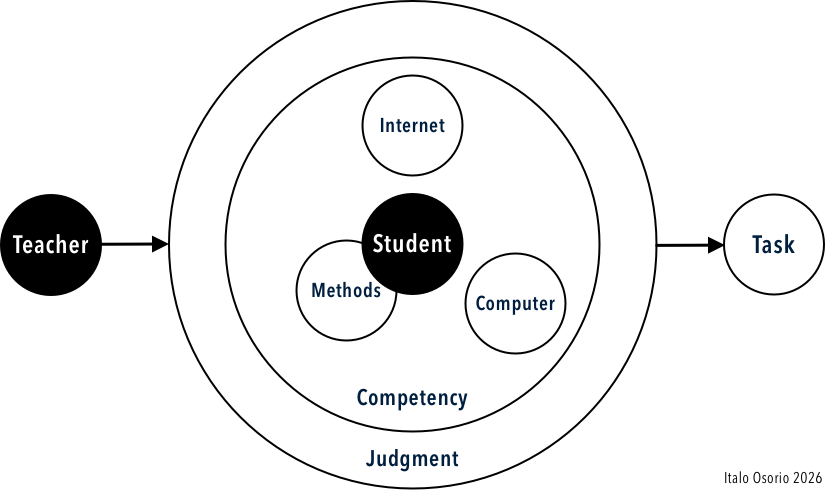
The personal computer and the internet inaugurated The Student as the Strategist. Knowledge became ubiquitously accessible; memorization gave way to mastery of search and discernment of information. The teacher’s primary task became teaching how to formulate effective queries, evaluate sources, navigate vast digital repositories, and synthesize retrieved information into coherent solutions. The student was no longer merely operating a single device but strategically commanding an entire networked knowledge system.
Student as the Orchestrator
We have now entered the Student as the Orchestrator period. Artificial intelligence supplies sophisticated reasoning methods and process design; robotics provides precise physical execution; massive, real-time data streams serve as raw material. AI can propose solutions, optimize workflows, and direct robotic agents—all at speeds and scales far beyond human capability. Students can learn independently around the clock, yet the teacher’s role is arguably more essential than ever. Only the human educator can determine whether the student truly comprehends the underlying principles, recognizes when AI suggestions should be overridden, and exercises ethical and contextual judgment about which problems merit which level of automation. The teacher alone can confirm that the student is not simply a passive recipient of AI output but a capable orchestrator who knows why a particular symphony of tools and methods is the wisest choice.
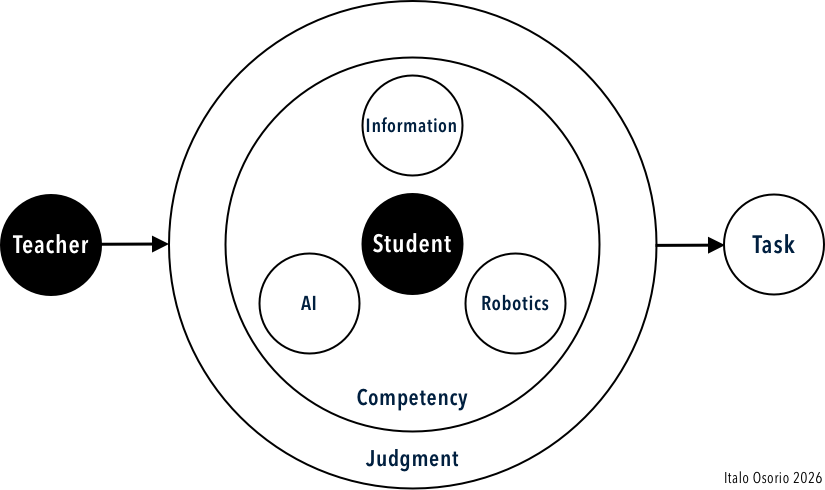
Across all four periods, the tools have advanced—from brain, to calculator, to networked information ecosystem, to AI-robotics partnership—yet the teacher’s irreplaceable contribution endures: validating authentic competence and cultivating discerning judgment. As the student’s role evolves from tool → operator → strategist → orchestrator, the educator remains the constant guarantor that intelligence, wisdom, and moral responsibility stay firmly in human hands.
Italo Osorio 2026
Photo by Katja Ano on Unsplash